
Sencha.煎茶
Steamed leaves, rolled and brewed.
A little warmth opens the leaves. The first sip may be savoury, sweet, grassy or brisk, depending on the tea and how you brew it. Sencha begins with the craft of keeping a green leaf green, and becomes something personal when water meets it.
Camellia sinensis
- Part
- leaf and bud
- As eaten
- steamed, rolled, dried, infused
- From
- Japan
The craft behind an everyday cup.
Sencha belongs to Japan’s loose-leaf green-tea tradition. The steaming and hand-rolling method developed in the Uji region in the eighteenth century helped shape the tea we recognise today: leaves heated soon after picking, rolled and dried. Japanese tea later became widespread in ordinary households as production and distribution developed.
That history matters because sencha is something made, not simply a fresh leaf put into water. Cultivation, harvest, steaming, rolling and finishing all contribute to the cup. Uji is one important history; it is not the origin of every sencha you can buy.
Making and sharing tea can give an ordinary moment more attention. The changing aroma, the temperature of the cup and the company at the table are all part of the experience.
Why steam changes the story.
A freshly picked tea leaf contains enzymes that can drive oxidation when its cells are disturbed. Early heating limits that activity. In sencha, steam does this work before rolling and drying, helping preserve a green-tea character rather than developing the fuller oxidation associated with red tea.
Rolling shapes the leaves into needles and changes how water can reach the leaf during brewing. More deeply steamed leaves tend to break into finer pieces. Those fragments can make an infusion cloudier and change its texture. A cloudy green cup is not automatically stronger in every compound.
Two moments of heat are involved: steam during manufacture, then hot water when you brew. A deeply steamed tea can still make a short infusion. Longer factory steaming does not mean you should leave the leaves sitting in your pot for longer.
A closer look.
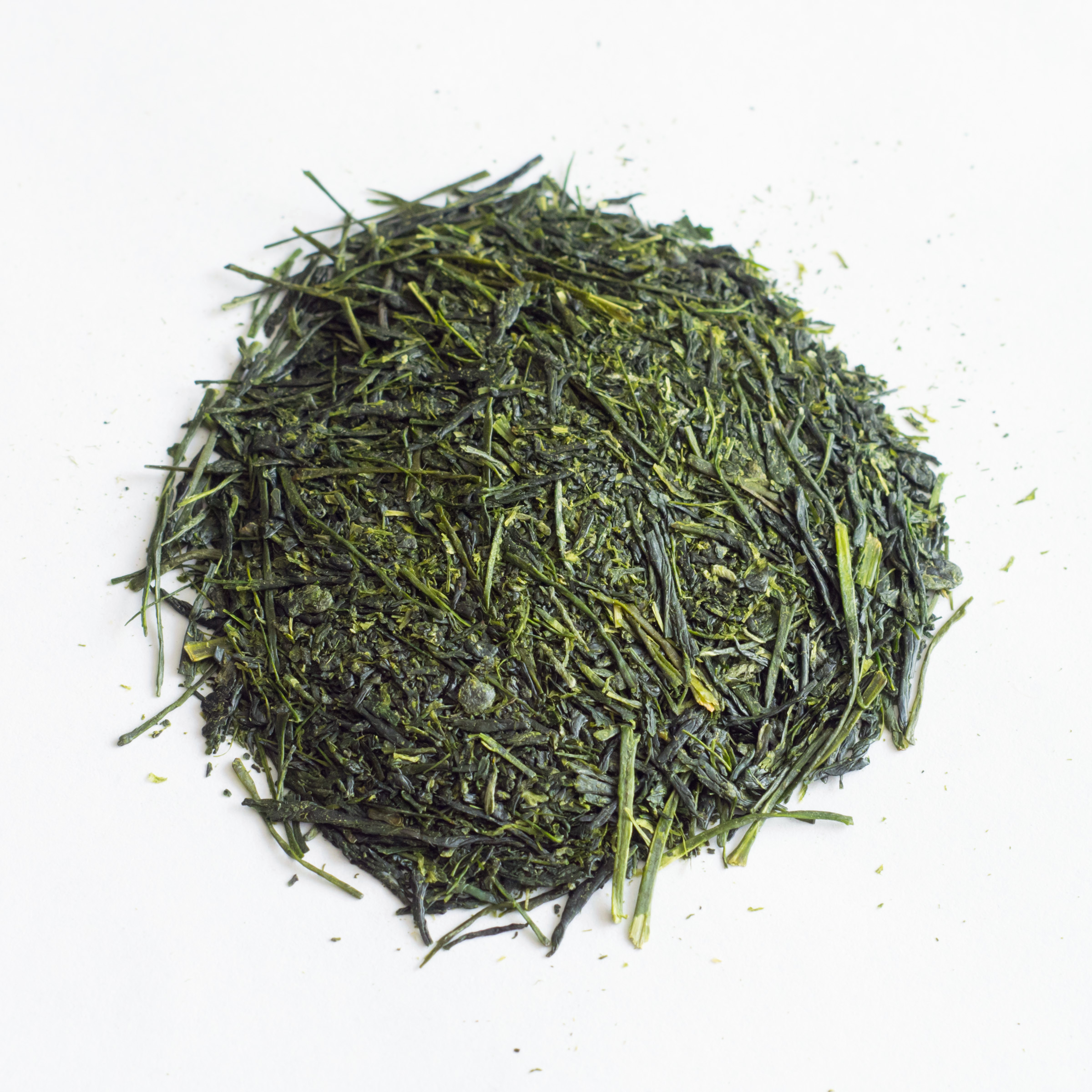
Needles that open in water.
Rolling and drying shape the leaf. Fine fragments from deeper steaming can make a cloudier cup without increasing every dissolved compound.
[4]Your part in the cup.
Leaf, water temperature and time shape the infusion. Change one at a time and notice what happens to sweetness, bitterness and texture.
[3]Sweetness, savouriness and a little grip.
Tea contains amino acids, caffeine and polyphenols, among many other compounds. Theanine is one of its amino acids. Catechins contribute to the bitterness and astringency of green tea, while amino acids contribute to its savoury character. Astringency is the drying, gripping sensation in the mouth; it is different from bitterness.
Water temperature, leaf quantity and time change what you extract. A hotter or longer brew often makes a more forceful cup. Cooler water can give you a gentler starting point. You are adjusting a balance of taste and texture, not turning a single “health” dial.
This is also why a dry-leaf nutrient table would mislead. You usually drink the infusion and leave the leaf behind. Fibre and much of the leaf material remain in the pot, while some soluble compounds enter the water.
Pleasure, hydration and stimulation.
An unsweetened sencha infusion is mostly water and supplies little food energy. It can be part of your fluid intake. It also contains caffeine, so it can make you feel more alert and can interfere with sleep when the amount or timing does not suit you. A pale-looking cup is not proof of low caffeine.
Theanine and caffeine have been studied together for their effects on attention, often using measured quantities of the isolated ingredients. Improvements in some attention tasks do not establish that every cup creates calm focus. Your leaf, brew, sensitivity and circumstances are different.
Likewise, catechins can show antioxidant activity in a laboratory without proving that a daily sencha will prevent a particular disease. The useful everyday case is simpler: an enjoyable unsweetened drink that you can brew to your taste. Its place in the day depends on whether the caffeine and the experience suit you.
Find the cup you want to drink.
For a first small pot, one established sencha method uses 10 g of leaf, 210 ml of water at 80°C and about 60 seconds. This is a fairly leaf-rich starting recipe, not a required daily amount. If the packet gives a method for your particular tea, begin there instead.
Pour the infusion out fully so the leaves do not keep steeping between cups. Then adjust one thing at a time: a little less leaf for a lighter cup, slightly cooler water or a shorter steep if it feels too harsh. Fine, deeply steamed leaves may need a shorter first infusion and a suitable strainer.
You can infuse the leaves again and notice how the cup changes. Judge aroma, taste and mouthfeel separately. Enjoy the second infusion for the different qualities it brings. Let the drink become comfortable to sip before drinking it.
A welcome tea, when it suits your day.
Choose sencha because you enjoy the particular leaf and the way it fits your life. Its craftsmanship, changing infusions and clean, unsweetened taste are substantial reasons to include it. It does not need to be ranked above every other tea.
Pay attention to caffeine. If a cup leaves you restless or disrupts sleep, make the next one lighter or earlier, or choose a caffeine-free drink. Children do not need caffeinated tea for nourishment; family activities can explore the dry leaf and a cooled infusion without tasting.
Brewed tea and concentrated green-tea extracts are different products. More concentrated is not automatically more beneficial. If pregnancy, breastfeeding or medicines make caffeine or extracts a concern, do not treat a general food page as a personalised dosing guide.
Watch a rolled leaf open.
An adult can brew a small pot and let it cool completely. Compare a dry needle-like leaf with an opened wet leaf. Look at the water’s colour against a white cup. No tasting is needed.
A question to take further
Can the colour alone tell you how much caffeine is in the cup? What other information would you need?
Sources & further reading.
References follow the numbers in the text. Food traditions, nutrient measurements and experiments answer different questions.
- Effects of different brewing conditions on catechin content and sensory acceptance in Turkish green tea infusions
TUBITAK Marmara Research Center, Food Institute · Original indexed abstract and results; nine trained panellists and chromatography
Checked 2026-10-29
- The proper way to brew Nihoncha
Japanese Ministry of Agriculture, Forestry and Fisheries · Tea types and brewing guide
Checked 2026-10-28
- How well do you know your sencha?
Ippodo Tea · Processing; Flavour; Standard sencha recipe
Checked 2026-10-28
- The Relationship Between Steaming Time and Composition of Chemical Constituents in Infusion of Green Tea
Takayanagi, Anan and Ikegaya, National Research Institute of Tea · Original English abstract directly read; 30, 60 and 150 second manufacture steaming treatments
Checked 2026-10-29
- The effects of L-theanine, caffeine and their combination on cognition and mood
Haskell and colleagues, Biological Psychology, 2008 · Original abstract: crossover experiment using isolated 250 mg theanine and 150 mg caffeine. Not a sencha-cup trial or a brewing recommendation.
Checked 2026-10-29
- Green tea: production
Tea Guardian · Production styles
Checked 2026-10-28
- Green tea: usefulness and safety
NCCIH · Background; What Do We Know About Safety?
Checked 2026-10-28
- Uji Tea: Traditional Foods in Japan
Ministry of Agriculture, Forestry and Fisheries, Japan · History of the Uji steaming and hand-rolling method; household use and methods. Exact history, not a claim that all sencha comes from Uji.
Checked 2026-10-29
Photograph
Kagoshima sencha: the dry leaf. Difference engine. Original image and attribution · CC BY-SA 4.0. None; original photograph.
