
Onion.
The bulb that starts so many meals.
An onion stores water and food reserves in fleshy leaf bases. Cut it and its chemistry becomes obvious; cook it and that same bulb takes on another character.
Allium cepa
- Part
- bulb
- As eaten
- fresh, cooked, cured
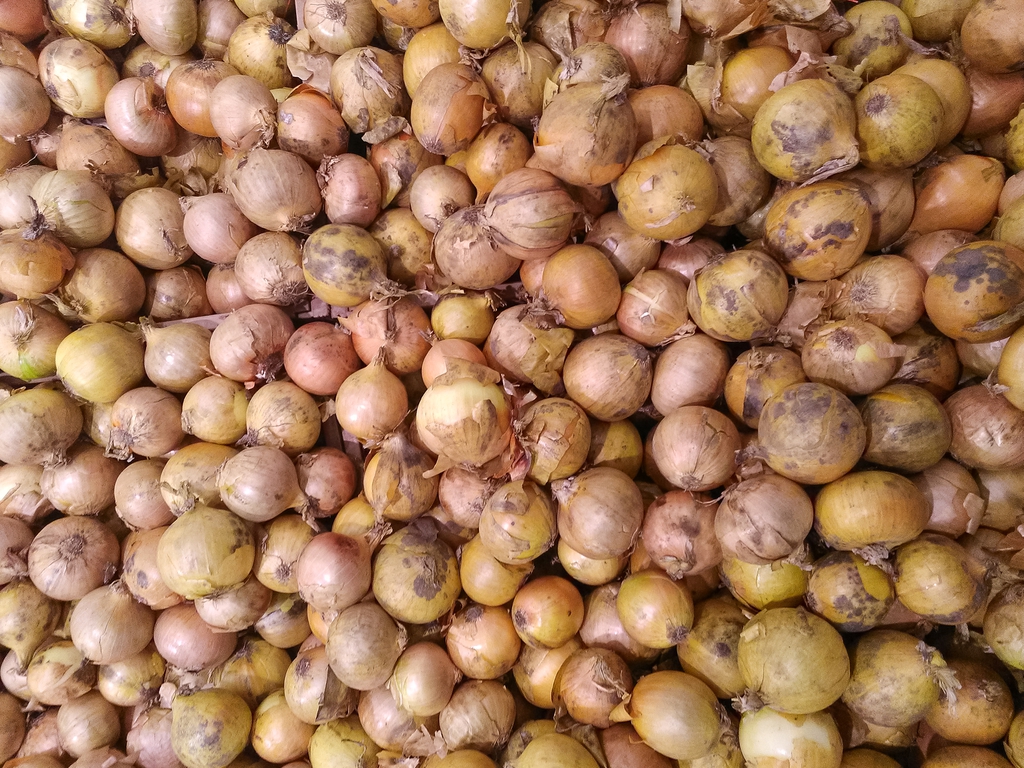
A foundation for sauces and relishes.
Onion bulbs are eaten raw, boiled and fried, and they have a substantial role in sauces and relishes across African food traditions. Some West African preparations also use pounded, dried or fermented onion leaves as seasonings.
These uses show the value of a supporting ingredient. Onion can give a dish aroma, texture and a base for other flavours without being the largest item on the plate. Bulb, leaf and shallot forms remain useful culinary distinctions.
Cutting brings the chemistry together.
The concentric layers are modified leaf bases. When they are cut, disrupted tissue allows a chain of chemical reactions to begin. A particular enzyme helps produce the volatile substance that makes eyes water.
The sharp response is not a sign that the onion is doing something beneficial to your body. It is part of the plant chemistry released during preparation. Cooking changes the texture and flavour again, which is why raw and softened onion can have such different jobs in a dish.
A closer look.
A foundation for sauces and relishes.
Onion bulbs are eaten raw, boiled and fried, and they have a substantial role in sauces and relishes across African food traditions. Some West African preparations also use pounded, dried or fermented onion leaves as seasonings.
[4]A useful food beyond its pungency.
Raw onion supplies water, carbohydrate and fibre. The reference has about 89 g water and 1.7 g fibre per 100 g. Its everyday value also lies in helping make vegetables, pulses and other foods appealing.
The amount of onion in a dish and the fat, salt or other ingredients used with it all matter. A dried seasoning and a large raw bulb are not the same food by weight.
A strong taste does not establish a stronger health effect. Onion can be worth using regularly for food and flavour without being assigned an antibacterial or cleansing role inside the body.
Choose sharpness or softness.
Use a small amount raw when a dish needs a sharp note, or cook it until it reaches the texture and flavour you want. Add it to lentils, beans, soups or other familiar meals.
If onion causes digestive discomfort, a smaller amount or another seasoning may suit you better. For family observation, look at the layers without deliberately exposing anyone to the vapour.
Our kitchen judgement: a useful foundation ingredient. Its ability to support a varied, enjoyable meal is more dependable than a dramatic health claim.
Look for the compressed plant.
An adult can show a halved onion during ordinary meal preparation. Identify the dry outer covering, fleshy layers, root end and growing tip. Keep the cut surface away from eyes and wash hands afterwards.
A question to take further
Which structures suggest that a bulb is more than a simple solid ball?
Nutrient explorer
What this food contributes.
Onions, raw. This is a reference sample, not a measurement of your food.
A weight comparison, not a serving recommendation.
| Nutrient | Amount |
|---|---|
| Energy | 40 kcal |
| Protein | 1.1 g |
| Fat | 0.1 g |
| Carbohydrate | 9.34 g |
| Fibre | 1.7 g |
| Potassium | 146 mg |
| Water | 89.11 g |
| Calcium | 23 mg |
| Iron | 0.21 mg |
| Magnesium | 10 mg |
| Vitamin C | 7.4 mg |
| Folate, DFE | 19 µg |
| Vitamin A, RAE | 0 µg |
| Beta-carotene | 1 µg |
| Vitamin K | 0.4 µg |
| Vitamin B12 | 0 µg |
| Vitamin D | 0 µg |
| Selenium | 0.5 µg |
| Zinc | 0.17 mg |
| Choline | 6.1 mg |
USDA SR28 (2015), NDB 11282. 100 g edible portion of this named reference preparation; not a measurement of a particular product. Values scale arithmetically; preparation and absorption are separate questions. Open the dataset.
Sources & further reading.
References follow the numbers in the text. Food traditions, nutrient measurements and experiments answer different questions.
- The Family Nutrition Guide: why we need to eat well
Food and Agriculture Organization · Topic 1; nutrient functions and mixed meals
Checked 2026-10-29
- Allium cepa
NC State Extension · Description; Edibility
Checked 2026-10-28
- An onion enzyme that makes the eyes water
Imai and colleagues, Nature; food and biological science laboratories · Original publisher abstract retrieved through publication index; full article unavailable
Checked 2026-10-29
- Allium cepa / PROTA
Plant Resources of Tropical Africa, Pl@ntUse · Uses and botanical description; historical agricultural handbook
Checked 2026-10-29
- USDA National Nutrient Database, Standard Reference 28
USDA Agricultural Research Service · FOOD_DES.txt and NUT_DATA.txt; exact NDB identifiers beside each table
Checked 2026-10-28
Photograph
onions. Filo gèn'. Original image and attribution · CC BY-SA 4.0. None; original file, fitted without cropping. Shown here fitted to a 4:3 frame.