
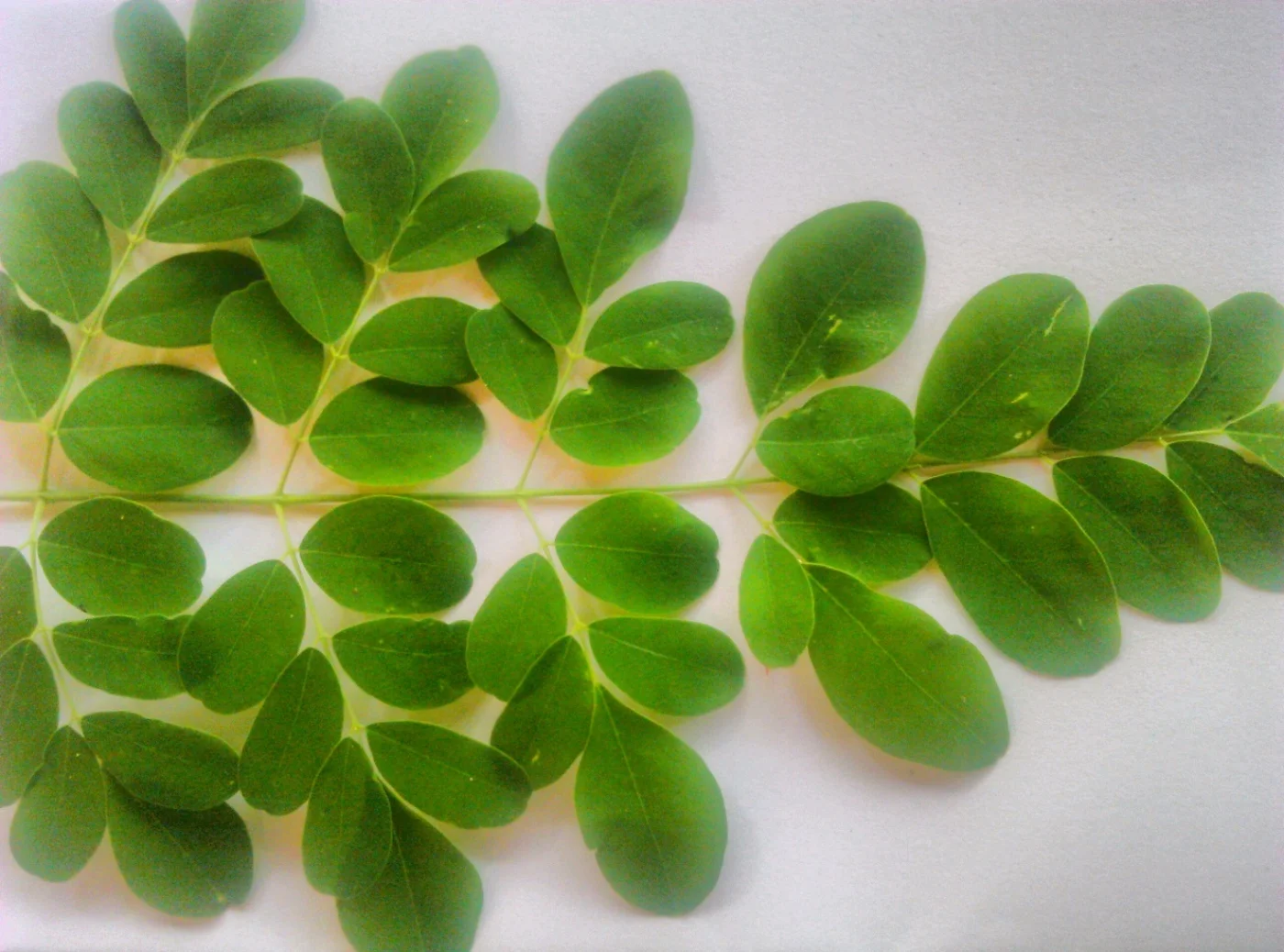
Moringa leaf.
Everyday greens, from India to Indonesia.
Moringa’s small leaflets are cooked as everyday greens: in clear Indonesian soups, Tamil dishes with pulses and coconut, and Filipino tinola. They contribute protein, minerals and carotenoid pigments to a meal, in amounts that depend on how much leaf you actually eat.
Moringa oleifera
- Part
- leaf
- As eaten
- fresh, cooked, dried
- From
- India
Murungai keerai, cooked as a green.
In Tamil cooking, moringa leaves are murungai keerai. They can become poriyal: a vegetable preparation with tempering spices, often finished with coconut. One familiar approach combines the leaves with shallots, mustard, cumin and a little cooked dal. The small leaflets become part of the finished dish.
Leafy vegetables and pulses bring different textures and nutrients to the plate. Preparing them together is one practical way to make a nourishing meal.
Indian traditions also use other parts of the moringa tree. The long drumstick pods, seeds, roots and bark are different materials. A claim or preparation associated with one of them should not be transferred to the leaves. Here, the subject is the edible leaf used in food.
Kelor in a pot of soup.
In Indonesia, kelor leaves are commonly cooked into sayur bening, a clear vegetable soup, or prepared as tumis, a sautéed dish. These simple methods make room for the leaf’s flavour alongside the rest of the meal. Moringa is also grown near homes and as a living fence in parts of South-East Asia, putting a leafy ingredient close to the kitchen.
There is practical knowledge in that pattern: a food plant can matter because it grows locally, can be harvested repeatedly and is easy to add to familiar cooking. Availability and familiarity are part of what makes the leaf useful.
A closer look.
Water is part of the food.
A fresh leaflet brings water, plant tissue and nutrients together. Its composition is measured on a fresh-weight basis.
[9]A different weight comparison.
Removing water concentrates many components per gram. Drying and storage can also change sensitive vitamins, so powder and fresh leaves are not equal spoon for spoon.
[4]Malunggay, broth and coconut milk.
In the Philippines, the same species is widely known as malunggay. Its leaves enter tinola, a chicken soup, and in Bicol they are also cooked in coconut milk with other ingredients. A thin broth and a coconut-rich dish show how differently one leaf can be eaten.
In tinola, the leaf is eaten with chicken and broth. A coconut-milk preparation brings more fat and a different texture. The other ingredients help determine how filling and energy-rich the meal is.
Eating the cooked leaves retains plant tissue that would be left behind in a strained drink. When comparing nourishment, the amount of leaf and the complete dish both matter.
What a small leaf brings.
Fresh moringa leaves contain protein, minerals and vitamins, including provitamin A carotenoids. The body can convert some of those carotenoids into vitamin A, which supports normal vision and the maintenance of tissues. The plant proteins are broken down into amino acids used throughout the body.
A reference sample of 100 g raw drumstick leaves contains 9.4 g protein, 185 mg calcium and 51.7 mg vitamin C. These are values for a substantial weight of fresh leaves, not for a spoonful of powder or a cup of strained leaf infusion. The explorer below lets you compare weights without pretending everyone eats the same portion.
Calcium contributes to bones and normal muscle and nerve function; vitamin C has roles in collagen formation and helps the body absorb non-haem iron from a meal. The food’s measured totals still do not tell us exactly how much any person will absorb. The rest of the meal and the way the leaves are prepared matter.
What digestion can make available.
The nutrients in a leaf are held within plant tissues and accompanied by other compounds. Preparation can change how readily some are released during digestion. A nutrient table is a starting point for understanding nourishment; it cannot predict exactly what reaches the bloodstream.
Iron is a good example. A food can contain iron while only some becomes available during digestion. Food-science experiments on moringa-containing porridges show why ingredients and preparation need to be studied together. A laboratory estimate of accessible iron is not the same as measuring absorption or recovery from iron deficiency in a person.
Fresh leaves and dried powder also deserve separate judgement. Drying removes water and concentrates many constituents by weight, while heat, light and storage can reduce sensitive vitamins. A powder may be useful as an ingredient, but a larger number per 100 g does not automatically make a small spoonful more nourishing than a serving of greens.
Bring it back to the kitchen.
Use leaves sold for food from a source you trust. Strip the small leaflets from tough stems, wash them and cook them in a familiar dish: a clear soup, a dal, a vegetable sauté or an egg dish. For a first attempt, start with a modest amount so you can learn the taste and texture.
A little oil or another fat-containing food is a sensible companion to leafy vegetables because carotenoids are fat-soluble. Add a squeeze of lime to the finished meal if you enjoy it; its vitamin C can support non-haem iron absorption.
Our judgement: moringa is worth including as one of several leafy foods, especially where fresh leaves are available locally. Choose the form you will actually cook and enjoy. Roots, bark, concentrated extracts and cosmetic oils do not inherit the leaf’s culinary use. A leaf meal and a medicinal product are different decisions.
Follow the little leaves.
Look at a food-grade moringa sprig or its photograph. Notice how many leaflets share a branching stem. Draw the whole sprig, then one leaflet. An adult can show how the leaflets are stripped for cooking.
A question to take further
What would you need to know before comparing a spoonful of dried powder with a handful of fresh leaves?
Nutrient explorer
What this food contributes.
Drumstick leaves, raw. This is a reference sample, not a measurement of your food.
A weight comparison, not a serving recommendation.
| Nutrient | Amount |
|---|---|
| Energy | 64 kcal |
| Protein | 9.4 g |
| Fat | 1.4 g |
| Carbohydrate | 8.28 g |
| Fibre | 2 g |
| Potassium | 337 mg |
| Water | 78.66 g |
| Calcium | 185 mg |
| Iron | 4 mg |
| Magnesium | 42 mg |
| Vitamin C | 51.7 mg |
| Folate, DFE | 40 µg |
| Vitamin A, RAE | 378 µg |
| Beta-carotene | Not reported |
| Vitamin K | Not reported |
| Vitamin B12 | 0 µg |
| Vitamin D | 0 µg |
| Selenium | 0.9 µg |
| Zinc | 0.6 mg |
| Choline | Not reported |
USDA SR28 (2015), NDB 11222. 100 g edible portion of this named reference preparation; not a measurement of a particular product. Values scale arithmetically; preparation and absorption are separate questions. Open the dataset.
Sources & further reading.
References follow the numbers in the text. Food traditions, nutrient measurements and experiments answer different questions.
- The Family Nutrition Guide: why we need to eat well
Food and Agriculture Organization · Topic 1; nutrient functions and mixed meals
Checked 2026-10-29
- Commercial malunggay production gaining ground in Bicol
Philippines Department of Agriculture, Bicol · UMAsenso, January–March 2016, feature on malunggay: coconut-milk dishes and tinola. Culinary and growing context, not the article’s medicinal claims.
Checked 2026-10-29
- Moringa oleifera
National Parks Board, Singapore · Leaves; Ethnobotanical Uses
Checked 2026-10-28
- Effect of dehydration methods on retention of carotenoids, tocopherols, ascorbic acid and antioxidant activity in Moringa oleifera leaves
Saini and colleagues, CSIR-Central Food Technological Research Institute · Original full text, abstract and sample/drying methods; PKM-1 leaves
Checked 2026-10-29
- Aneka olahan daun kelor
Indonesian Ministry of Agriculture · 22 November 2023, paragraph on sayur bening and tumis. Only documented culinary uses adopted; promotional health and nutrient comparisons not adopted.
Checked 2026-10-29
- Potential of moringa leaf and baobab fruit food-to-food fortification of wholegrain maize porridge to improve iron and zinc bioaccessibility
Adetola and colleagues, LWT, 2021 · Indexed original abstract; in-vitro mineral bioaccessibility in a particular porridge mixture. Not human absorption or anaemia treatment.
Checked 2026-10-29
- Murungai keerai poriyal: drumstick leaf preparation
Dindigul Food Court · Creator’s recipe description, 29 September 2021: leaves, mustard, urad dal, cumin, shallots, cooked moong dal and coconut. A particular Tamil cooking example, not a universal recipe.
Checked 2026-10-29
- Moringa oleifera / PROSEA
Plant Resources of South-East Asia, hosted by Pl@ntUse · Uses and botanical description; historical handbook, not current production statistics
Checked 2026-10-29
- USDA National Nutrient Database, Standard Reference 28
USDA Agricultural Research Service · FOOD_DES.txt and NUT_DATA.txt; exact NDB identifiers beside each table
Checked 2026-10-28
Photograph
Moringa oleifera: a branch of edible leaflets. Abin jv at Malayalam Wikipedia. Original image and attribution · CC BY 3.0. Resized to 1400 pixels wide and encoded as WebP; no crop or retouching..
