
Tomato.
Fresh brightness, deep cooked flavour.
A tomato is a fruit in botanical terms and a versatile ingredient in savoury cooking. Fresh slices, sauces, purées and dried pieces each make use of it differently.
Solanum lycopersicum
- Part
- fruit
- As eaten
- ripe, fresh, cooked
- From
- South America
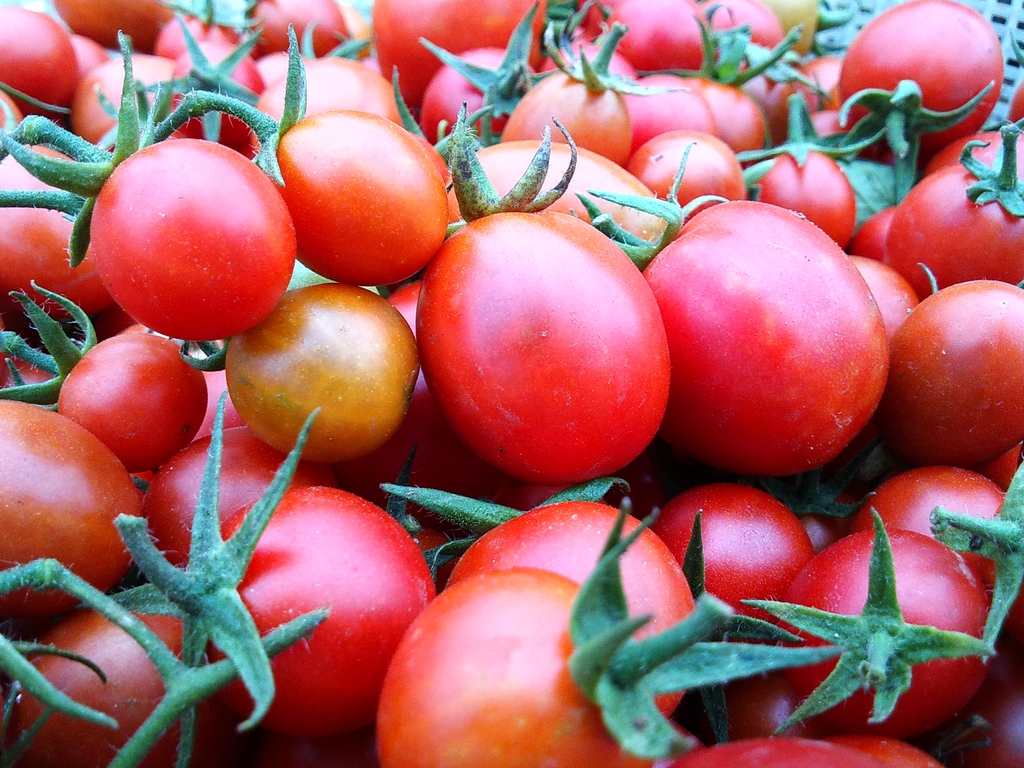
The same fruit takes many forms.
Tomatoes are eaten fresh and made into soups, sauces, purées and dried foods. Cutting a fresh one reveals seed-bearing chambers and watery tissue. Cooking draws the flesh and liquid together into another texture.
These preparations preserve different pleasures. A slice can bring freshness to a meal; a cooked sauce can carry flavour through beans, grains or other ingredients. One does not have to replace the other.
Heat changes more than one nutrient at once.
Tomatoes contain lycopene, a carotenoid associated with their red colour, as well as vitamin C. Heating can make some lycopene more accessible from the tissue while reducing vitamin C under the same conditions.
That trade-off is more useful than a rule that raw or cooked is always superior. Laboratory accessibility is not identical to absorption in a person, but it shows why softening the plant structure can matter. Concentrating a sauce also removes water, changing the amount per spoonful.
A closer look.
The same fruit takes many forms.
Tomatoes are eaten fresh and made into soups, sauces, purées and dried foods. Cutting a fresh one reveals seed-bearing chambers and watery tissue. Cooking draws the flesh and liquid together into another texture.
[3]Several contributions in one ingredient.
Fresh tomato supplies water, vitamin C, fibre and potassium alongside carotenoids. Vitamin C supports normal tissue maintenance and helps with non-haem iron absorption from a meal.
Cooked tomato can contribute differently, especially when it forms part of a dish with some fat and other foods. Neither a raw slice nor a sauce needs a disease-prevention promise to be useful.
Compare like with like when reading numbers. Tomato paste is concentrated, while a raw tomato contains much more water. Salt, oil and other sauce ingredients also affect the finished dish.
Keep both fresh and cooked in the kitchen.
Use fresh tomato where you want a bright, juicy texture. Simmer it into a sauce when you want its flavour to bind a dish together. A little oil can be part of that preparation, not an error to remove at all costs.
Choose sound fruit and store prepared food appropriately. If acidic food does not agree with you, use an amount and preparation that feel comfortable.
Our kitchen judgement: valuable for flavour, variety and several nutrients. Its ability to make other nourishing foods enjoyable is part of the benefit.
Map the chambers.
Cut two familiar tomato varieties across the middle with adult help. Count the visible seed chambers and draw their shape. Do not assume that more chambers means better nutrition.
A question to take further
Which observations describe anatomy, and which would require a chemical measurement?
Nutrient explorer
What this food contributes.
Tomatoes, red, ripe, raw, year round average. This is a reference sample, not a measurement of your food.
A weight comparison, not a serving recommendation.
| Nutrient | Amount |
|---|---|
| Energy | 18 kcal |
| Protein | 0.88 g |
| Fat | 0.2 g |
| Carbohydrate | 3.89 g |
| Fibre | 1.2 g |
| Potassium | 237 mg |
| Water | 94.52 g |
| Calcium | 10 mg |
| Iron | 0.27 mg |
| Magnesium | 11 mg |
| Vitamin C | 13.7 mg |
| Folate, DFE | 15 µg |
| Vitamin A, RAE | 42 µg |
| Beta-carotene | 449 µg |
| Vitamin K | 7.9 µg |
| Vitamin B12 | 0 µg |
| Vitamin D | 0 µg |
| Selenium | 0 µg |
| Zinc | 0.17 mg |
| Choline | 6.7 mg |
USDA SR28 (2015), NDB 11529. 100 g edible portion, as described in this record. Values scale arithmetically; preparation and absorption are separate questions. Open the dataset.
Sources & further reading.
References follow the numbers in the text. Food traditions, nutrient measurements and experiments answer different questions.
- The Family Nutrition Guide: why we need to eat well
Food and Agriculture Organization · Topic 1; nutrient functions and mixed meals
Checked 2026-10-29
- Solanum lycopersicum · Plant Toolbox
NC State Extension · Description and plant characteristics
Checked 2026-10-28
- Lycopersicon esculentum / PROSEA
Plant Resources of South-East Asia, hosted by Pl@ntUse · Uses and botanical description; historical handbook, not current production statistics
Checked 2026-10-29
- Thermal Processing Enhances the Nutritional Value of Tomatoes by Increasing Total Antioxidant Activity
Dewanto and colleagues, Journal of Agricultural and Food Chemistry · Original publisher abstract retrieved through publication index; food experiment, not a human trial
Checked 2026-10-29
- USDA National Nutrient Database, Standard Reference 28
USDA Agricultural Research Service · FOOD_DES.txt and NUT_DATA.txt; exact NDB identifiers beside each table
Checked 2026-10-28
Photograph
Solanum lycopersicum. Color and different sizes of fruit. Anh Van. Original image and attribution · Public Domain Mark 1.0. None; original file, fitted without cropping. Shown here fitted to a 4:3 frame.