
Butternut squash.
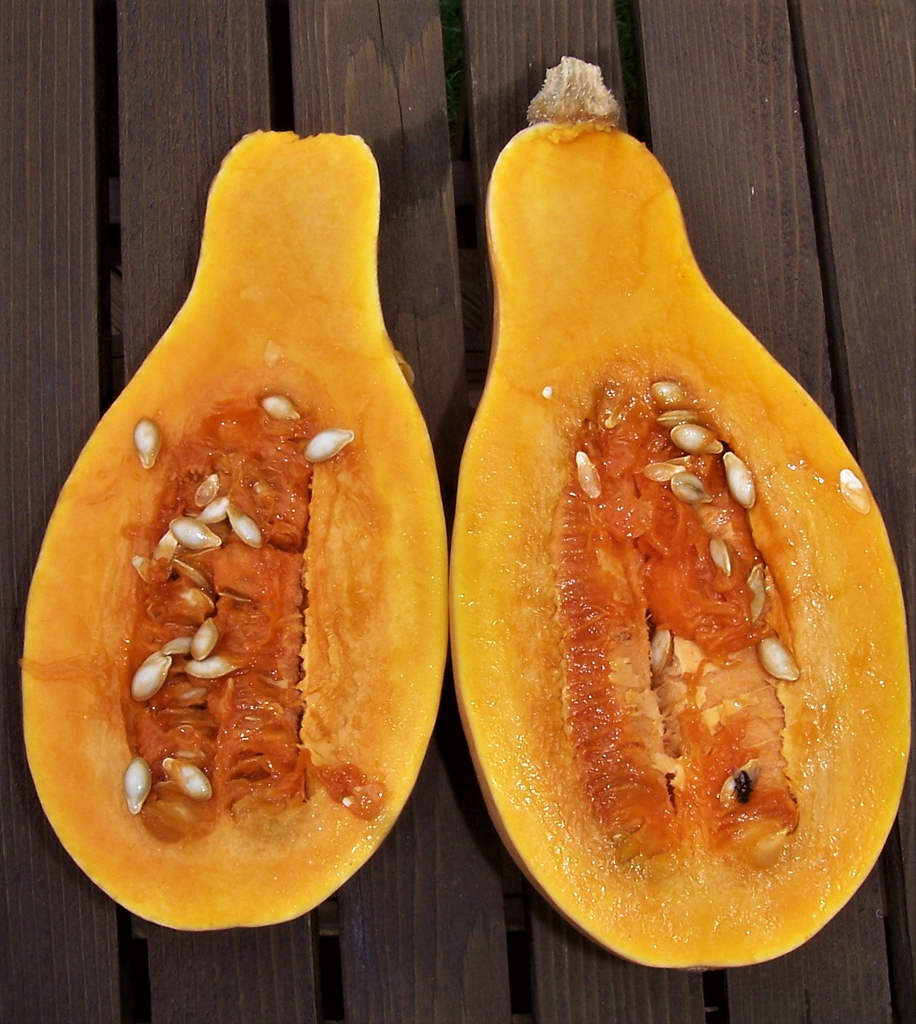
Orange flesh inside a keeping squash.
Butternut is a mature squash with a firm rind, a seed cavity and sweet orange flesh. Cooking turns that flesh into an ingredient for soups, savoury dishes and sweet preparations.
Cucurbita moschata
- Part
- mature fruit flesh
- As eaten
- baked, cooked
- From
- Central and South America
A mature squash in many kitchens.
Cucurbita moschata has diverse food uses, including cooked mature flesh in African cuisines and sweet steamed preparations with coconut and sugar in South-East Asia. Drying has also been used to preserve the flesh.
Those traditions belong to a wider species with many forms; they do not mean every historical squash was the modern butternut cultivar. The shared practical idea is a mature fruit whose flesh can be cooked in several ways and kept beyond the moment of harvest.
Maturity and cooking both matter.
Orange squash contains carotenoid pigments. Their amounts can change as the fruit matures, and cooking can change them again. More mature samples of one butternut-type cultivar have contained more alpha- and beta-carotene than less mature ones.
A particular cooking treatment may reduce a measured amount while also softening the tissue. Colour alone cannot tell you exactly how much a person will absorb. Maturity, variety and the method all belong to the result.
A closer look.
A mature squash in many kitchens.
Cucurbita moschata has diverse food uses, including cooked mature flesh in African cuisines and sweet steamed preparations with coconut and sugar in South-East Asia. Drying has also been used to preserve the flesh.
[3]Carotenoids, fibre and food energy.
Butternut contributes carbohydrate, fibre and provitamin A carotenoids. The body can convert some of those pigments into vitamin A, which supports normal vision and tissues. A little fat in the meal can help with carotenoid absorption.
The reference on this page is baked butternut squash without salt. It contains 3.2 g fibre and 558 µg vitamin A RAE per 100 g. RAE expresses vitamin A activity; it is not an extra pigment to add to the beta-carotene figure.
Squash can make a satisfying part of a meal, especially with beans, eggs or another protein food. Sweetness does not remove its vegetable contribution.
Use the soft flesh generously.
Roast pieces until tender, simmer them into soup or mash the cooked flesh into a dish you already enjoy. Handle the firm rind with a stable board and an appropriate knife.
If using coconut milk, butter, oil or sugar, include those as deliberate ingredients rather than assuming the squash’s name describes the whole dish.
Our kitchen judgement: a useful keeping vegetable with colour, fibre and provitamin A. It can be enjoyed in a sweet tradition or a savoury meal without needing to make one culturally “correct” choice.
Draw the two spaces inside.
An adult can open a squash for a meal. Compare the solid neck with the seed cavity in the rounder end. Draw both cross-sections and label flesh, rind and seeds.
A question to take further
Why would two slices from the same fruit have different proportions of edible flesh?
Nutrient explorer
What this food contributes.
Squash, winter, butternut, cooked, baked, without salt. This is a reference sample, not a measurement of your food.
A weight comparison, not a serving recommendation.
| Nutrient | Amount |
|---|---|
| Energy | 40 kcal |
| Protein | 0.9 g |
| Fat | 0.09 g |
| Carbohydrate | 10.49 g |
| Fibre | 3.2 g |
| Potassium | 284 mg |
| Water | 87.8 g |
| Calcium | 41 mg |
| Iron | 0.6 mg |
| Magnesium | 29 mg |
| Vitamin C | 15.1 mg |
| Folate, DFE | 19 µg |
| Vitamin A, RAE | 558 µg |
| Beta-carotene | 4570 µg |
| Vitamin K | 1 µg |
| Vitamin B12 | 0 µg |
| Vitamin D | 0 µg |
| Selenium | 0.5 µg |
| Zinc | 0.13 mg |
| Choline | Not reported |
USDA SR28 (2015), NDB 11486. 100 g edible portion, as described in this record. Values scale arithmetically; preparation and absorption are separate questions. Open the dataset.
Sources & further reading.
References follow the numbers in the text. Food traditions, nutrient measurements and experiments answer different questions.
- The Family Nutrition Guide: why we need to eat well
Food and Agriculture Organization · Topic 1; nutrient functions and mixed meals
Checked 2026-10-29
- Cucurbita moschata · Plant Toolbox
NC State Extension · Description and plant characteristics
Checked 2026-10-28
- Cucurbita moschata / PROTA
Plant Resources of Tropical Africa, Pl@ntUse · Uses and botanical description; historical agricultural handbook
Checked 2026-10-29
- α-Carotene and β-Carotene Content in Raw and Cooked Pulp of Three Mature Stage Winter Squash “Type Butternut”
Zaccari and Galietta, Foods; Universidad de la República · Original full text, methods and wet-weight tables; one cultivar
Checked 2026-10-29
- USDA National Nutrient Database, Standard Reference 28
USDA Agricultural Research Service · FOOD_DES.txt and NUT_DATA.txt; exact NDB identifiers beside each table
Checked 2026-10-28
Photograph
Dissected Fruit. Girish Bhatt. Original image and attribution · CC BY-SA 4.0. None; original file, fitted without cropping. Shown here fitted to a 4:3 frame.