
Turmeric.
Kunyit: colour and flavour from an underground stem.
Turmeric brings a deep yellow-orange colour to food. Fresh rhizome and dried powder are familiar kitchen ingredients, with different water content and intensity.
Curcuma longa
- Part
- rhizome
- As eaten
- fresh, dried, ground
- From
- South and Southeast Asian cultivation
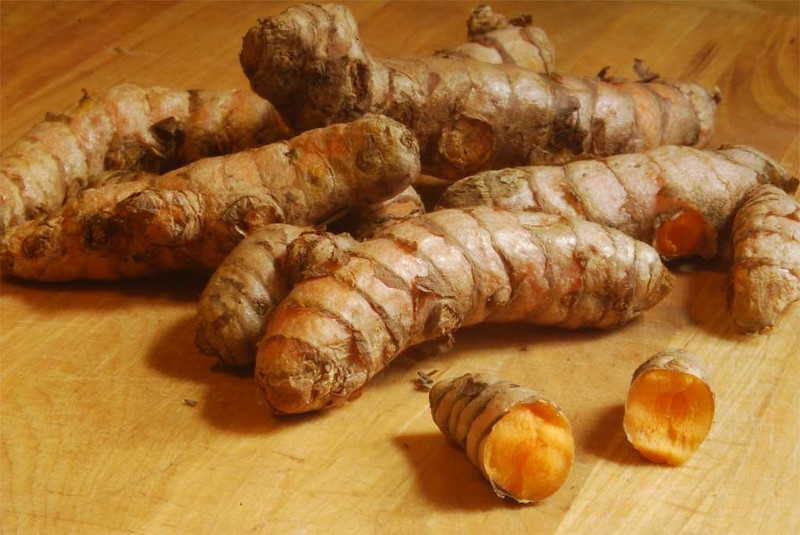
Kunyit and kunir in Asian kitchens.
Turmeric, Curcuma longa, has a substantial culinary role in Asian dishes. In Indonesia it is known by names including kunyit and kunir. Fresh rhizomes can be grated into a paste, while dried powder gives another practical form of the spice.
The plant is one member of a wider Curcuma group. Young rhizomes and shoots also have vegetable uses in some food traditions. Keeping the species and edible part clear helps preserve the actual knowledge rather than turning every orange rhizome into the same ingredient.
The recipe changes the chemistry.
Turmeric’s pigments and other compounds meet heat, water and other ingredients in the pan. Boiling, pressure cooking and combinations with foods such as pulses or tamarind create different chemical conditions.
Those conditions affect the amount of particular compounds retained. A curry is therefore a food system, not simply a delivery vehicle for isolated curcumin. The colour you see is useful for cooking, but it is not a measurement of an effect inside the body.
A closer look.
Kunyit and kunir in Asian kitchens.
Turmeric, Curcuma longa, has a substantial culinary role in Asian dishes. In Indonesia it is known by names including kunyit and kunir. Fresh rhizomes can be grated into a paste, while dried powder gives another practical form of the spice.
[3]A spice-sized contribution.
Ground turmeric contains fibre and minerals, but culinary amounts are usually small. A 2 g comparison of the dried spice supplies about 6 kcal and 0.45 g fibre in the reference data. Its most immediate contribution is colour, flavour and the pleasure of the meal.
Curcumin is one constituent studied separately from the food. The presence of that compound does not make every turmeric dish a treatment. Fresh rhizome, dried powder and products designed for enhanced absorption are different exposures.
A useful place for turmeric is within varied cooking that includes vegetables, pulses and other nourishing foods.
Let it belong to a dish.
Use fresh or dried turmeric in a recipe suited to that form, such as a vegetable or pulse preparation. Begin with a modest amount and adjust for flavour. It stains readily, so use a surface and utensils you can clean.
Do not assume concentrated curcumin products share the safety of ordinary spice use. Some enhanced-absorption supplements have been linked to liver injury; that is a separate decision from cooking with turmeric.
Our kitchen judgement: a valuable culinary spice. It can help make everyday food appealing without needing a promise to treat inflammation or replace care.
Track where the colour goes.
An adult can show a small amount of food-grade turmeric in an ordinary recipe. Observe which ingredients it colours. Protect clothing and surfaces from stains; no skin application is part of the activity.
A question to take further
Does visible colour measure the amount of every compound in the food?
Nutrient explorer
What this food contributes.
Spices, turmeric, ground. This is a reference sample, not a measurement of your food.
A weight comparison, not a serving recommendation.
| Nutrient | Amount |
|---|---|
| Energy | 312 kcal |
| Protein | 9.68 g |
| Fat | 3.25 g |
| Carbohydrate | 67.14 g |
| Fibre | 22.7 g |
| Potassium | 2080 mg |
| Water | 12.85 g |
| Calcium | 168 mg |
| Iron | 55 mg |
| Magnesium | 208 mg |
| Vitamin C | 0.7 mg |
| Folate, DFE | 20 µg |
| Vitamin A, RAE | 0 µg |
| Beta-carotene | 0 µg |
| Vitamin K | 13.4 µg |
| Vitamin B12 | 0 µg |
| Vitamin D | 0 µg |
| Selenium | 6.2 µg |
| Zinc | 4.5 mg |
| Choline | 49.2 mg |
USDA SR28 (2015), NDB 02043. 100 g edible portion of this named reference preparation; not a measurement of a particular product. Values scale arithmetically; preparation and absorption are separate questions. Open the dataset.
Kitchen use and concentrated products
Some curcumin supplements designed for enhanced absorption have been linked to liver injury. Those formulations are different from turmeric used as food. Supplement use during pregnancy may be unsafe. [1]
Sources & further reading.
References follow the numbers in the text. Food traditions, nutrient measurements and experiments answer different questions.
- Turmeric: usefulness and safety
US National Center for Complementary and Integrative Health · Background; What Do We Know About Safety?
Checked 2026-10-28
- Curcuma longa · Plant Toolbox
NC State Extension · Description and plant characteristics
Checked 2026-10-28
- Curcuma longa / PROSEA
Plant Resources of South-East Asia, hosted by Pl@ntUse · Uses and botanical description; historical handbook, not current production statistics
Checked 2026-10-29
- Effect of heat processing of spices on the concentrations of their bioactive principles
Journal of Food Composition and Analysis · Original publisher methods excerpt through index; boiling and pressure cooking with food ingredients
Checked 2026-10-29
- USDA National Nutrient Database, Standard Reference 28
USDA Agricultural Research Service · FOOD_DES.txt and NUT_DATA.txt; exact NDB identifiers beside each table
Checked 2026-10-28
Photograph
Curcuma longa rhizomes. Howard Walfish. Original image and attribution · CC-BY-SA 2.0. None; original file, fitted without cropping. Shown here fitted to a 4:3 frame.