
Fenugreek seed.
A legume seed used as a spice.
Fenugreek brings a distinctive flavour to spice mixtures and other preparations. Its seed and its leafy greens are different foods, even though they come from the same plant.
Trigonella foenum-graecum
- Part
- seed
- As eaten
- dried, cooked
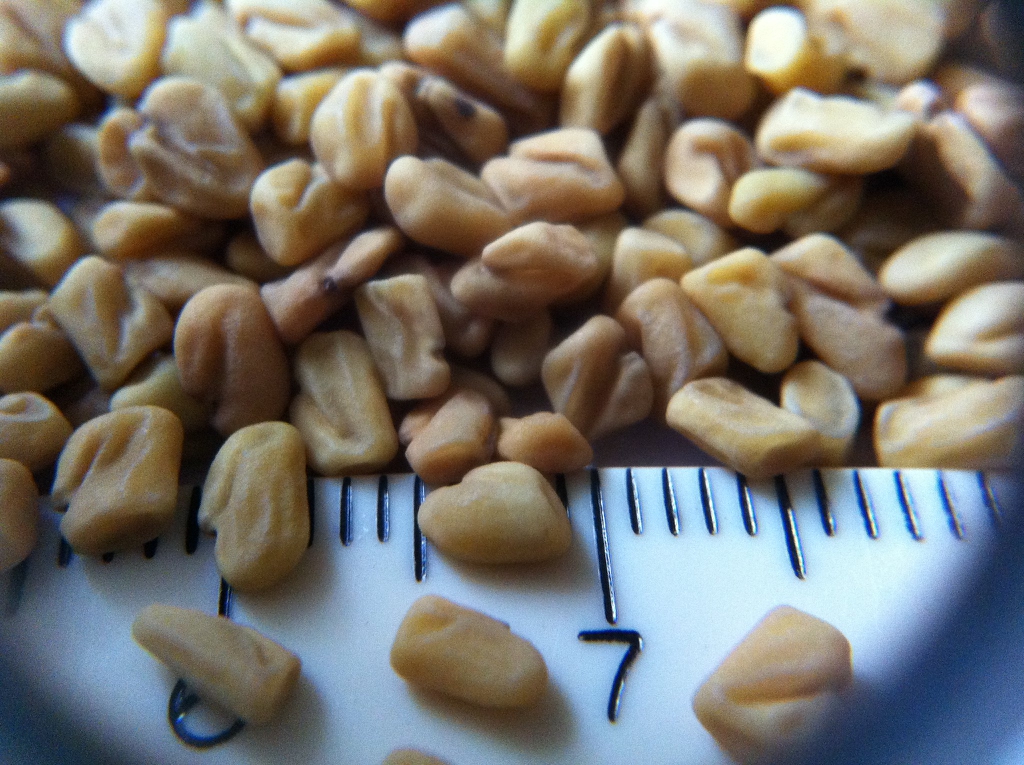
Whole, ground, roasted and mixed.
Fenugreek seed is used in Asian spice mixtures, North African breads and Arab hulba preparations. Both leaves and seeds of Trigonella foenum-graecum enter food, but they have different compositions and culinary roles.
Roasting, grinding and soaking are practical choices about flavour and texture. A particular household or regional preparation deserves its own method rather than being reduced to one universal fenugreek recipe.
A seed flour carries its processing history.
Raw, soaked, germinated and roasted fenugreek seed flours can differ in phenolic measurements and laboratory antioxidant tests. Water, growth and heat are doing different things to the seed.
A higher result in one laboratory assay does not make that preparation automatically better to eat. It also does not mean home sprouting is necessary. Taste, safe handling and the purpose of the recipe belong in the decision.
A closer look.
Whole, ground, roasted and mixed.
Fenugreek seed is used in Asian spice mixtures, North African breads and Arab hulba preparations. Both leaves and seeds of Trigonella foenum-graecum enter food, but they have different compositions and culinary roles.
[4]A spice with a fibre-rich seed structure.
Fenugreek seeds contain protein and fibre, but the amount used as seasoning is usually much smaller than the 100 g reference. A small quantity should not be imagined as a complete pulse serving.
Its reputation for effects on blood sugar or milk supply is a different question from its culinary role. Ordinary food use and larger medicinal exposures cannot be treated as equivalent.
The useful everyday approach is to let it contribute flavour within a varied meal. You can value a traditional preparation without turning its ingredient into a therapeutic dose.
Use a recipe that understands the seed.
Begin with a familiar spice mixture, bread or hulba preparation and follow its method. Fenugreek can dominate a dish, so learn its flavour in a modest amount before improvising.
Larger-than-food amounts can cause digestive effects, allergy and other problems; they are unsafe in pregnancy. Do not infer supplement safety from a small amount used in cooking.
Our kitchen judgement: a distinctive spice worth learning through food traditions. Its ordinary culinary use is a clearer starting point than a concentrated daily regimen.
Look closely at the seed.
Use a labelled packet of food-grade fenugreek to draw the seed’s angular shape. Compare whole seed with a ground spice used in a familiar meal. No medicinal tasting or home germination is needed.
A question to take further
Which features are still visible after grinding?
Nutrient explorer
What this food contributes.
Spices, fenugreek seed. This is a reference sample, not a measurement of your food.
A weight comparison, not a serving recommendation.
| Nutrient | Amount |
|---|---|
| Energy | 323 kcal |
| Protein | 23 g |
| Fat | 6.41 g |
| Carbohydrate | 58.35 g |
| Fibre | 24.6 g |
| Potassium | 770 mg |
| Water | 8.84 g |
| Calcium | 176 mg |
| Iron | 33.53 mg |
| Magnesium | 191 mg |
| Vitamin C | 3 mg |
| Folate, DFE | 57 µg |
| Vitamin A, RAE | 3 µg |
| Beta-carotene | Not reported |
| Vitamin K | Not reported |
| Vitamin B12 | 0 µg |
| Vitamin D | 0 µg |
| Selenium | 6.3 µg |
| Zinc | 2.5 mg |
| Choline | Not reported |
USDA SR28 (2015), NDB 02019. 100 g edible portion, as described in this record. Values scale arithmetically; preparation and absorption are separate questions. Open the dataset.
Food amounts and larger exposures
Ordinary food use differs from larger amounts. Larger amounts can lower blood sugar and cause digestive symptoms or allergy. Amounts beyond food use are unsafe during pregnancy; breastfeeding and child supplement safety is uncertain. [2]
Sources & further reading.
References follow the numbers in the text. Food traditions, nutrient measurements and experiments answer different questions.
- Effect of processing techniques on nutritional composition and antioxidant activity of fenugreek seed flour
Journal of Food Science and Technology · Original food experiment abstract/results; no clinical conclusions adopted
Checked 2026-10-29
- Fenugreek: usefulness and safety
US National Center for Complementary and Integrative Health · Background; What Do We Know About Safety?
Checked 2026-10-28
- Trigonella foenum graecum · Plant Toolbox
NC State Extension · Description and plant characteristics
Checked 2026-10-28
- Trigonella foenum-graecum / PROSEA
Plant Resources of South-East Asia, hosted by Pl@ntUse · Uses and botanical description; historical handbook, not current production statistics
Checked 2026-10-29
- USDA National Nutrient Database, Standard Reference 28
USDA Agricultural Research Service · FOOD_DES.txt and NUT_DATA.txt; exact NDB identifiers beside each table
Checked 2026-10-28
Photograph
Seeds. Krzysztof Ziarnek, Kenraiz. Original image and attribution · CC BY-SA 4.0. None; original file, fitted without cropping. Shown here fitted to a 4:3 frame.